
VIDA OGNJENOVIĆ
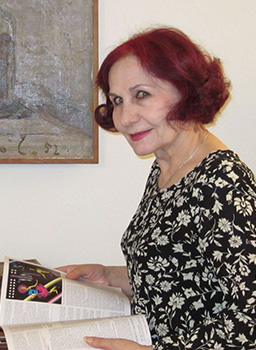 Born in Dubočke, in the vicinity of Nikšić, and has been living in Serbia since her early childhood.
She completed her primary education in Vrbas, and high school in Sremski Karlovci. She graduated at
the Department of General Literature at the Faculty of Philology in Belgrade, as well as at the
department of directing at the Faculty of Dramatic Arts in Belgrade.
Born in Dubočke, in the vicinity of Nikšić, and has been living in Serbia since her early childhood.
She completed her primary education in Vrbas, and high school in Sremski Karlovci. She graduated at
the Department of General Literature at the Faculty of Philology in Belgrade, as well as at the
department of directing at the Faculty of Dramatic Arts in Belgrade.
She had started her post-graduate studies at Sorbonne, Paris,
and she had defended her master's
thesis in the theory and practice of directing at the University of Minnesota, USA, as a fellow of
the Fulbright Foundation (1972).
From 1974 to 1979 she worked as an assistant professor at the FDA in Begrade. In 1977 she was
appointed a stage director of the National Theatre in Belgrade, and, following the completion
of her four-year term of office, she stay employed there as a resident director.
In her capacity of a Fulbright Professor, she taught at the universities in Los Angeles (UCLA),
1981-1982, Chicago
(UIC, Columbia College) (1996, 1998, 2000), and, in her capacity of guest lecturers,
she had toured most of the bigger universities in the USA (1985, 1991, 1997, 1999). She is a regular
professor at the Academy of Arts in Novi Sad and at the Academy of Fine Arts in Belgrade.
Literary output
Collection of short stories:
“Otrovno mleko maslačka“ (The Poisonous Milk of the Dandelion) (Prosveta, Belgrade, 1994),
“Stari Sat” (The Grandfather’s Clock) (Prosveta, Belgrade, 1996),
“Najlepše pripovetke Vide Ognjenović” (The Best Stories by Vida Ognjenović) (Prosveta, Belgrade, 2001),
“Prava adresa” (The Right Address) (DOO: Dnevnik, Novi Sad, 2007).
“Živi primeri” (Living Examples) (Arhipelag, Belgrade, 2012)
Novels:
“Kuća mrtvih mirisa”(The House of Dead Scents) (Prosveta, Belgrade, 1995),
“Preljubnici” (Adulterers) (Stubovi kulture, 2007).
“Posmatrač Ptica” (The Birdwatcher) (Arhipelag, Belgrade, 2011)
Prose travelogue
“Putovanje u putopis” (Travels Through Geography) (Zrenjaninska biblioteka, 2005).
Collection of Essays:
“Nasuprot proročanstvu” (Against the Prophecy) (Arhipelag, Belgrade, 2007),
“Visoka Voltaža” (High Voltage) (Arhipelag, Belgrade, 2014)
Collection of interviews:
“Nema više naivnih pitanja” (No More Naive Questions) (Dnevnik, 2008).
Books of plays:
“Kanjoš Macedonović” ( Oktoih, 1989, 94, 2004),
“Melanholične drame” (Melancholy Dramas) ( SKZ, 1991),
“Setne komedije” (Somber Comedies) ( SKZ, 1993),
“Devojka modre kose” (The Blue Haired Girl) (Ars dramatica, Belgrade, 1994),
“Mileva Ajnštajn” (Mileva Einstein) ( Stubovi Kulture, 1988, 2002)
“Jegorov put” (Igor’s Road) (Oktoih, 2001),
Collections of plays in three volumes:
Drame I, II, III (Plays I, II, III) (Stubovi kulture, 2000,2001,2002),
“Don Krsto” (Oktoih, 2007)
Literary Awards.
Among other:
Prosveta Award (book of the year, 1994),
Andrić Award (short story award, 1995),
Branko Ćopić Award (prose, 1996),
Laza Kostić Award (novel, 1996),
Karolj Sirmai Award (short stories, 1996),
Ramonda Serbica Award (prose, 1998),
Stefan Mitrov Ljubiša Award (literary work, 1999).
Todor Manojlović Award, (modern literary expression, 2004)
Milica Stojadinović –Srpkinja Award (prose, 2007)
National Library Award (book of the year, 2007)
Kočićevo pero Award (prose, 2012)
Her fiction and plays have been translated in English, Hungarian, Italian, Greek, Bulgarian, Czech, Macedonian, Romanian, Ukrainian, German and Danish languages.
She is publishing translations from English and German language. She is living and working in Belgrade.
AHMET ÜMIT
 Ahmet Ümit was born in 1960. An active member of the Turkish Communist Party from 1974 until 1989,
he took part
Ahmet Ümit was born in 1960. An active member of the Turkish Communist Party from 1974 until 1989,
he took part
in the underground movement for democracy while Turkey was under the rule of a military
dictatorship between 1980-1990.
He illegally attended the Academy for Social Sciences in Moscow in
the eighties. One of Turkey’s most renowned contemporary authors, he is especially well-known for
his mastery of the mystery genre, as reflected in many of his bestselling novels and short story volumes.
Drawing upon the unique political and historical background, Ahmet Ümit delves into the psyches of his
well-wrought characters as he weaves enthralling tales of murder and political intrigue.
A Voice Divides the Night (Bir Ses Böler Geceyi), 1994, novel;
A Tale Within A Tale (Masal Masal İçinde), 1995, short stories;
The Fog and The Night (Sis ve Gece), 1996, novel;
The Smell of Snow (Kar Kokusu), 1998, novel;
Patasana (Patasana), 2000, novel;
The Devil is Hidden in the Details (Şeytan Ayrıntıda Gizlidir), 2002, short stories;
The Puppet (Kukla), 2002, novel;
Beyoglu Rhapsody (Beyoğlu Rapsodisi), 2003, novel;
The Man Who Spoke the Language of Jesus (Kavim), 2006, novel;
Ninatta’s Bracelet (Ninatta’nın Bileziği), 2006, novel;
The Dervish Gate (Bab-ı Esrar), 2008, novel;
A Memento for Istanbul (İstanbul Hatırası), 2010, novel;
Killing The Sultan (Sultanı Öldürmek), 2012, novel;
When Pera Trees Whisper (Beyoğlu’nun En Güzel Abisi), 2013, novel.
BEN BLUSHI
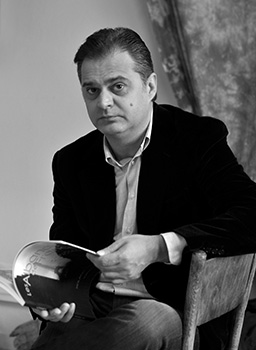 Ben Blushi was born in Tirana in 1969. He studied at the University of Tirana, graduating in Albanian Language
and Literature, from Tirana University, Faculty of Philology. He was editor-in-chief of the newspaper “Koha Jonë”,
and in 1999 embarked upon a political career in the cabinet of the Prime Minister of Albania. For several months
he served as Deputy Minister of Foreign Affairs, in late 2000 he became the Prefect of Korça, and in 2011 he was
appointed Minister of Education. Blushi is currently a Member of Parliament, representing the Socialist Party.
Ben Blushi was born in Tirana in 1969. He studied at the University of Tirana, graduating in Albanian Language
and Literature, from Tirana University, Faculty of Philology. He was editor-in-chief of the newspaper “Koha Jonë”,
and in 1999 embarked upon a political career in the cabinet of the Prime Minister of Albania. For several months
he served as Deputy Minister of Foreign Affairs, in late 2000 he became the Prefect of Korça, and in 2011 he was
appointed Minister of Education. Blushi is currently a Member of Parliament, representing the Socialist Party.
Blushi’s talent came about at a mature age and he has been enviously prolific: four novels in five years.
In April 2008, Blushi's first novel “Të jetosh në ishull” (Living on an Island) was published, which turned
into a phenomenal success. Indeed, within a couple of months, the book had sold over 30,000 copies, a record
for the Albanian market. Blushi’s 400-page novel offers the reader a panorama of Albanian history under the
Ottoman Empire from the 15th to the 18th centuries, with a broad and not uncontroversial treatment of the
country’s Islamisation. His acclaimed second novel “Otello, Arapi i Vlorës” (Othello, The Moor of Vlora)
appeared one year later, followed in 2011 by his third novel “Shqipëria” (Albania). With the novel “Otello,
Arapi i Vlorës”, Blushi was awarded the Author of the Year Prize at the Tirana Book Fair in 2009.
The three novels form a triptych of quality new Albanian literature and represent a cultural phenomenon
which deserves to go beyond Albania in the forthcoming decade. In April 2014, Blushi had a book of
essays published, “Hëna e Shqipërisë” (The Moon of Albania).
Blushi’s name and work shattered the Albanian literary scene: tens of thousands of copies sold and
an unprecedented ensuing debate in the media and the literary cycles. In the last twenty years, Blushi
is regarded as the writer with the greatest number of copies per book sold.
In 2014, Blushi was awarded “2014 European Union Prize for Literature (EUPL)”, “For the overall quality
and creativity of the book “Othello, the Moor of Vlora” (Otello, Arapi i Vlorës), available through the EU's
Creative Europe Programme, in collaboration with The European Booksellers Federation (EBF),
The European Writers Council (EWC), and The Federation of European Publishers (FEP).
POLONA GLAVAN
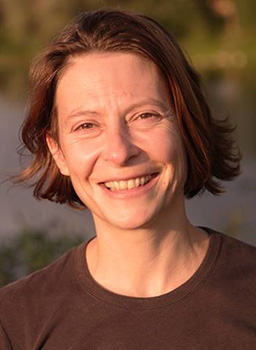 Polona Glavan is a Slovene writer and translator whose short stories have been included in anthologies
of Slovene short proseTime for Short Stories (1999) and What We Talk About (2004). Her first novel
A Night in Europe (2001) was one of
Polona Glavan is a Slovene writer and translator whose short stories have been included in anthologies
of Slovene short proseTime for Short Stories (1999) and What We Talk About (2004). Her first novel
A Night in Europe (2001) was one of
the finalists for the Slovene Novel of the Year Award and has been
translated into Czech (Agite), Macedonian (Ars Lamina) and Hungarian (Typotex). As in this novel, unusual
fates are also the main feature that links her collection of short stories entitled Guerrillas (2004).
Individual stories from the book
have been translated and published in over 10 languages. Glavan has
received numerous awards for her writing and is also a translator of contemporary American, English and
Irish literature. Her latest novel is No matter how (2014).
ALIDA BREMER
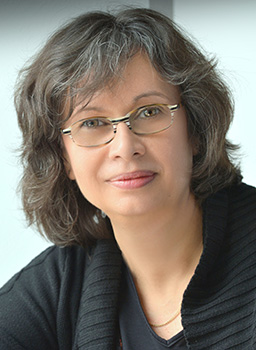 Born 1959 in Split. Lives in Münster, Germany, married with two children, occasionally resides in Split.
Has studied comparative literature, Slavistics, Germanistics, and Romance Studies in Belgrade,
Rome (scholarship granted by the Italian Government), Saarbrücken, and Münster. She completed her doctoral
studies at the department of comparative literature at the University of Saarbrücken, with a doctoral thesis
titled “Criminalistic Deconstruction: The Poetics of the Post-Modern Crime Novel”.
Since 1987 she has been a scientific associate at various scientific and research institutes,
universities and projects, from 1991 to 2005 (intermittently) she has been a proofreader of
Bosnian/Croatian/Serbian language and literature at the universities in Münster and Giessen.
From 2005 to 2008 she has worked as a scientific associate of the Gender Studies Centre
(Giessener Interdisziplinäre Arbeitsstelle Gender Studies) at the Justus-Liebig University in Giessen.
Leader of the project Depiction of the Dead Female Body in the Slavic Literatures. Her exhibition
The Twilight of Heroes: The Patriarchic Culture in South-East Europe has been staged in Zürich, Berlin,
and Giessen. She has published various publications in the sphere of gender studies.
From 2008 to the present day she has the status of a freelance author and translator in Germany.
She has published numerous publications in the fields of comparative literature, theory of
literature and Slavistics, as well as essays, poetry and prose works.
She has translated a great number of articles, essays, plays, short stories, collections of poems,
and novels from Croatian and Serbian into German language, and edited several books and magazine
special editions. Together with Saša Ilić, since 2014 she has been editing and publishing
“Beton International”, a social and literary magazine in German language. She is an associate
of a number of magazines, as well as of numerous literary institutions and festivals in the
German-speaking areas. In 2013 she has been decorated by a decision of the President of
the Republic of Croatia with the medal “Order of Danica Hrvatska bearing the face of Marko Marulić“
for her distinguished service in the promotion of Croatian literature in Germany.
She has also been a recipient of the “Grenzgänger” scholarship granted by the
Robert Bosch Stiftung Foundation (2008), the fellowship for writing (Internationales Haus der Autoren Graz, 2010.)
and translating (Deutscher Übersetzerfonds, 2011.). Her novel „Olivas Garten“ was published in Gernam language
in 2013 by the publishing house “Eichborn”, in Macedonian language in 2014 by the publishing house “Goten”,
and in Croatian language in 2015 by the publishing house “Fraktura”.
From 2008 to 2014 she has been working as an associate of the S. Fischer Stiftung Foundation from Berlin,
and within this institution she has been the leader of the Traduki project (Traduki is an international
network for promotion of literature, established by the Ministries of Foreign Affairs of Germany and Austria,
KulturKontakt Austria, Pro Helvetia, Goethe Institute and S. Fischer Stiftung). The has led the project
“South-East Europe in the Focus” at the Book Fair in Leipzig from 2009 to 2014. She is a member of the
Croatian PEN Centre and the German Association of Freelance Translators.
DIMITAR BASHEVSKI
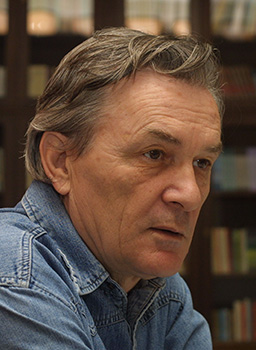 Dimitar Bashevski (1943), novelist, short story writer, poet, translator and publisher.
Graduated from the Faculty of humanities at the Sts. Cyril and Methodius University in Skopje.
Many years he worked as a journalist, foreign correspondent from Athens, Greece, and editor.
He was a director and editor-in-chief of Kultura Publishing House in Skopje. Currently he is
editor-in-chief of Slovo Publishing House. From 2000 to 2006 he was president and then
honorary president of the Macedonian PEN Centre.
Dimitar Bashevski (1943), novelist, short story writer, poet, translator and publisher.
Graduated from the Faculty of humanities at the Sts. Cyril and Methodius University in Skopje.
Many years he worked as a journalist, foreign correspondent from Athens, Greece, and editor.
He was a director and editor-in-chief of Kultura Publishing House in Skopje. Currently he is
editor-in-chief of Slovo Publishing House. From 2000 to 2006 he was president and then
honorary president of the Macedonian PEN Centre.
Author of the following works: Stranger (Tuginec), novel, 1969; Return (Vrakanje) novel, 1972;
Splinter (Raska) novel, 1974; While the Bell tolls there is no death (Nema smrt dodeka zvoni),
novel, 1980; A year in the life of Ivan Plevnesh (Edna godina od zivotot na Ivan Plevnesh), novel,
1985; The House of Life (Kukata na zivotot), poetry, 1987; The Sarajanovo Carnation (Sarajanovskiot karanfil),
novel, 1990; Anya’s Diary (Dnevnikot na Anja), novel for children, 1994; Temporal Stay (Privremen prestoj),
poetry, 1995; Time overcome (Sovladano vreme), poetry, 1998; The Well (Bunar), novel, 2001; Cornerstone
(Agolen kamen), poetry, 2005 and The Brother (Bratot), novel, 2007; Reading from my Hand
(Vo dlankata svoja si gledam), poetry, 2010; Windows (Prozorci), novel, 2010; Mark. Dream (Beleg. Son),
poetry, 2012; Windows, new version (Prozorci, nova verzija), novel, 2013 and The Master
(Majstorot) short stories, 2013.
Some of Bashevski’s books have been translated and published in English, Czech, Greek, Romanian, Serbian, Turkish, Albanian and Montenegreen
For his works, he has received the highest Macedonian literature awards - 11 October (11 Oktomvri),
Racin Award (Racinovo priznanie), Pechalbarska povelba Award (Pecalbarska povelba),Vancho Nikoleski (Vanco Nikoleski)
Award and Novel of the Year Award (Roman na godinata) for the novel The Well.